
Sidetracking is an established mature-field tool because it reuses casing, slots and surface infrastructure to reach bypassed or undrained volumes. The complication appears when the host well is not depleted. A conventional sidetrack can reach the next target while permanently removing a production path that still has reservoir value.
Start with remaining hydrocarbons, not the completion system
Candidate ranking should begin with remaining and bypassed hydrocarbons, geological and dynamic uncertainty, production history and incremental recoverable volume. Published mature-field workflows from PETRONAS and other operators follow this sequence: establish the reservoir opportunity first, then select the well architecture and completion response.
| New target — limited value | New target — material value | |
|---|---|---|
| Parent bore — little remaining value | Intervention, deferment or abandonment may be preferable. | Conventional sidetrack can be highly attractive. |
| Parent bore — material remaining value | Preserve the existing producer. | Key screening case: can the new target be accessed without destroying the existing drainage path? |
What TAML-3 Lite changes
The public engineering concept is simple: create a cased-hole departure while protecting the parent bore during construction, complete the additional lateral, then restore the intended production path from the original bore. This is a functional description, not a running procedure.
1 · Set and orient
Establish the casing-exit system and orientation reference for the planned departure.
2 · Construct the lateral
Create the casing exit and drill the additional reservoir contact while the parent bore is temporarily protected.
3 · Complete the lateral
Install the lower-completion arrangement selected for reservoir and operating conditions.
4 · Restore production intent
Remove the specified temporary restriction and return the required flow paths to service.
Important: “one-trip casing exit” refers to the principal setting and milling package. Lateral drilling, lower-completion installation, testing and production commissioning remain separate operations.
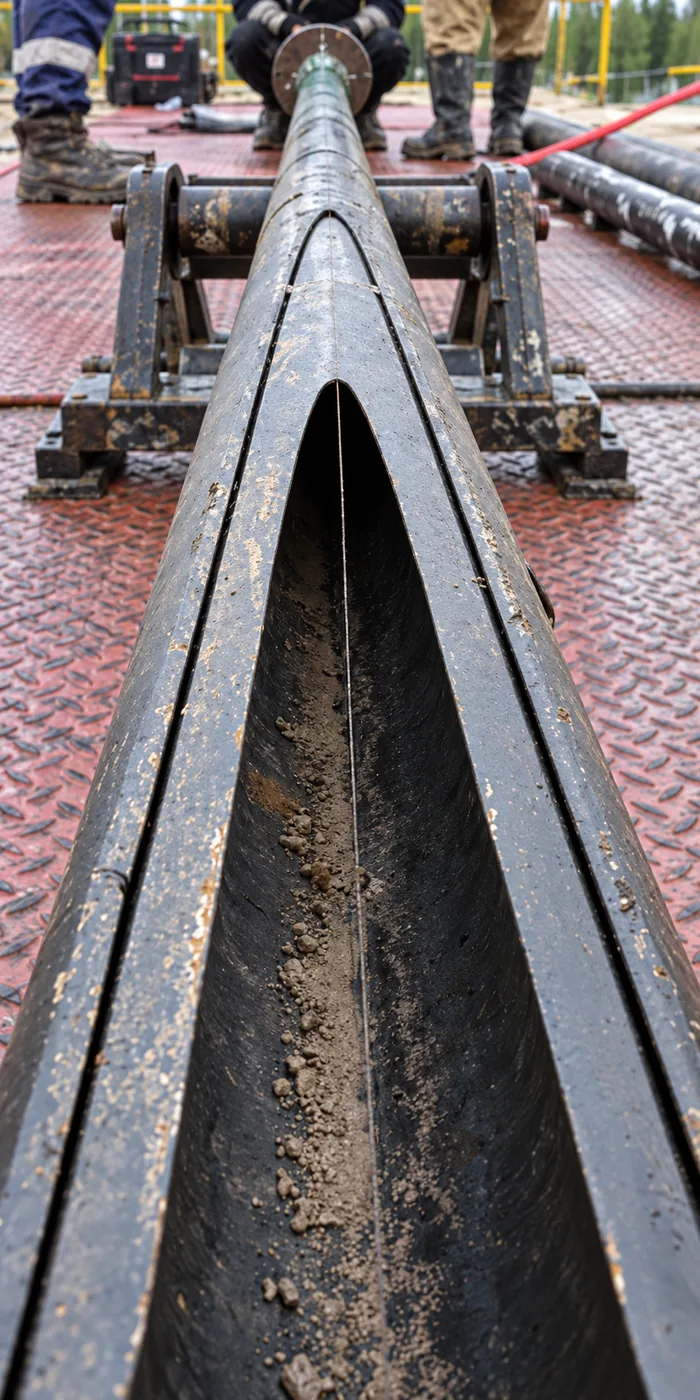
Temporary isolation is not the same as junction integrity
A temporary barrier that protects the parent bore during lateral construction does not by itself establish permanent hydraulic isolation between branches. Mechanical junction support and long-term pressure integrity are also separate functions. TAML terminology is useful, but it should follow the functional requirements: branch support, construction protection, commingling or selectivity, intervention access and lifecycle pressure requirements.
The reservoir questions are more important than the hardware
- How much recoverable volume remains in the parent drainage area?
- Does the lateral contact genuinely undrained reservoir?
- Are the two regions in pressure communication?
- Does the lateral add recovery, accelerate reserves or redistribute rate?
- What are the relative water- or gas-breakthrough risks?
- Is commingled production acceptable?
- How will branch contribution be monitored?
- Does retained-parent value justify the added completion and lifecycle complexity?
Field evidence and modeled economics must stay separate
Reported field implementation
A supplied RN-Vankor reference reports the production rate increasing after the additional lateral was brought into operation while the parent bore remained productive.
This is a reported field result from one implementation. It is not a prediction that another candidate will double production.
Separate TPU economic model
In a separate 2021–2026 economic model, the retained-parent alternative was modeled with approximately +3.4% CAPEX, +26.5% cumulative oil and +27.3% NPV versus the comparison case.
Modeled result, not a field forecast and not an Oman project forecast.
Why this matters in mature and offshore fields
The decision becomes more material when the parent bore represents not only current production but also an occupied slot, upper-hole investment, completion, artificial-lift interface, surveillance history and future intervention path. Public examples from Xijiang 24-3 and Goliat show operators using multilateral architecture when preserving existing well value or scarce offshore infrastructure materially affected the development decision.
The screening question is therefore not “Can we install a multilateral system?” It is: does the candidate contain enough value in both the existing drainage path and the new target to justify preserving both?
Public evidence boundary
This article intentionally publishes the development problem, functional architecture, evidence and limitations — not the execution recipe. Detailed BHA configuration, exact tool geometry, setting parameters, milling parameters, temporary-isolation design, contingency logic and acceptance criteria remain well-specific engineering information.
Sources and further reading
- SPE-176040-MS — Locating the Remaining Oil in a Mature Field in the Tertiary Baram Delta, Malaysia. Used for mature-field remaining-oil / candidate-screening context.
- SPE-117377-MS — Integrated Approach for Horizontal Side Track Candidate Selection in Sorochinsko-Nikolskoe Oil Field. Used for sidetrack candidate-screening context.
- Offshore Magazine — Xijiang 24-3 mature offshore multilateral case. Used for the parent-production preservation example.
- SLB — Vår Energi Goliat retrofit multilateral case. Used for the offshore slot/infrastructure preservation example.
- SLB Oilfield Review — The Defining Series: Multilateral Wells. Used for TAML classification context.
- RN-Vankor supplied field reference. Used for the reported 40 → 80 t/d field result and parent-bore-retention concept. Detailed tool dimensions and operating procedure are intentionally not reproduced here.
- I.V. Anikin, TPU MSc dissertation (2021), Section 4. Used for the separate modeled economic comparison. Values are presented as model results, not field forecasts.